Strategy meets neuroscience.
ScaleGrow is a two-person firm. Every engagement is led by both of us. There are no account managers, no junior teams, no handoffs between the people who sell the work and the people who do it.
We take six project clients at any one time.
Finds where the problem actually is. Almost never where the client thinks.
Identifies the cognitive mechanism behind the behavioral finding.
The insight did not come from a theory. It came from a pattern. Across the first ten engagements, every client arrived with the same belief: the problem was the page. The homepage was not converting. The onboarding flow was losing people. The pricing page was unclear.
And then Stage 2 would run. And in engagement after engagement, the behavioral evidence pointed somewhere else. The acquisition funnel had promised something the product could not deliver. The page spoke to the compliance department when the actual buyer was a clinical operations lead. The onboarding experience contradicted the mental model the buyer arrived with. The page was not the problem. The page was carrying the weight of a misalignment created earlier in the funnel. Every redesign that had been attempted before had addressed the symptom and left the cause intact. That is why the lift did not hold.
CID is the methodology built around that discovery. Start with diagnosis. Find the actual source. Design from the evidence forward. The 3.2x average lift across 127 engagements is not the result of better design execution. It is the result of designing from a more accurate diagnosis.
After 127 B2B conversion engagements, the pattern Mayank surfaces in every Stage 3 presentation is consistent: the conversion problem is almost never located where the company thinks it is. The page is almost never the problem.
He leads every CID engagement from Signal Collection through to the Design Intelligence Presentation. Before founding ScaleGrow, he led product and growth at Series A and B fintech and healthtech companies, raised funding, and sat inside the board conversations where a 1% conversion lift is a $2M ARR decision. He has sat on the operator's side of a conversion metric and understands what a 1% lift means at the board level, not just in an analytics dashboard. That context shapes how Stage 3 findings are delivered and why clients act on them.

In Stage 2 of every CID engagement, Shiromani produces the finding that changes the direction of the project. Not a heuristic review. A behavioral diagnosis: identifying precisely where the buying decision breaks down at the cognitive level, naming the mechanism behind the failure, and framing the finding as a testable hypothesis that Stage 4 can be designed to address.
She applies the frameworks from her neuroscience training to commercial conversion problems: cognitive load theory, dual-process thinking, attention hierarchy, trust signal sequencing, and decision friction analysis. She has applied this framework across 127 engagements in fintech, healthtech, and B2B SaaS.
Why This Combination Produces Results That Hold
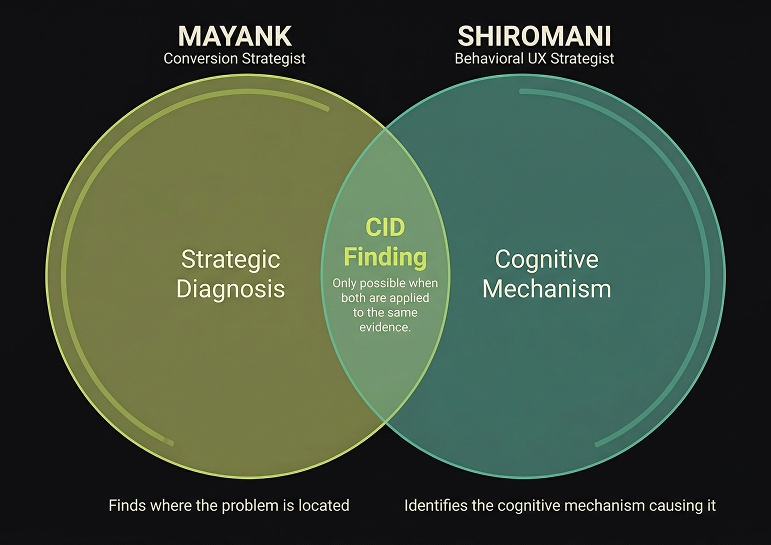
Mayank identifies where the problem is located and what strategic change is required. Shiromani identifies the precise cognitive mechanism causing it and the behavioral principle that, if applied correctly in Stage 4, will address the cause rather than the symptom. The CID finding is only possible when both instruments are applied to the same evidence. Neither one alone produces it.
Every design decision ScaleGrow produces has a neuroscience-grounded rationale behind it. That is not a differentiator claim. It is what the process actually produces: a Figma file where any designer can read why each decision was made, and conversion results that hold when the engagement ends because the cause was fixed, not the symptom.
ScaleGrow takes a maximum of six simultaneous project clients. Engagements, backed by $47M in documented revenue impact across 127 projects, start at $18,000. We do not take on engagements where we cannot lead the process from Signal Collection through to Stage 5 handoff. Clients who arrive with a fully-formed brief and want execution without diagnosis will not get what the CID process is capable of producing.
Our primary work is with funded B2B companies in SaaS, fintech, healthcare technology, and climate tech, and e-commerce companies with complex, measurable conversion problems. The criterion that matters most: whether the client has already tried to fix it and found the lift did not hold.
"Historically, our best work has been with funded B2B companies who have already tried to fix the conversion problem themselves."
Mayank, Principal, ScaleGrow
Stages 1 and 2 of CID, delivered as a standalone diagnostic. We review your page before we meet. The 90-minute session is led by us. A prioritized report in 48 hours.
$3,500 · 90 minutes · Report in 48 hours
Maximum six concurrent engagements. Current availability at booking.
A free behavioral diagnostic built on the same framework as Stage 2. Your score in five minutes, plus one behavioral insight from a real CID engagement delivered every week.